
| Funding Agencies | THE SCIENTIFIC AND TECHNOLOGICAL RESEARCH COUNCIL OF TURKEY (TÜBİTAK) & HUNGARIAN RESEARCH, DEVELOPMENT AND INNOVATION OFFICE (NRDIO) |
| Program | 2522 – Bilateral Cooperation Call |
| ID/Acronym | 125N359(360) / AXIS |
| Grant Period | March 2026 – March 2028 |
| Principal Investigator @ IzTech | Dr. Mehmet İsmet Can Dede |
| Project Partners |
|
| Project Researchers and Consultants |
|
Aim:
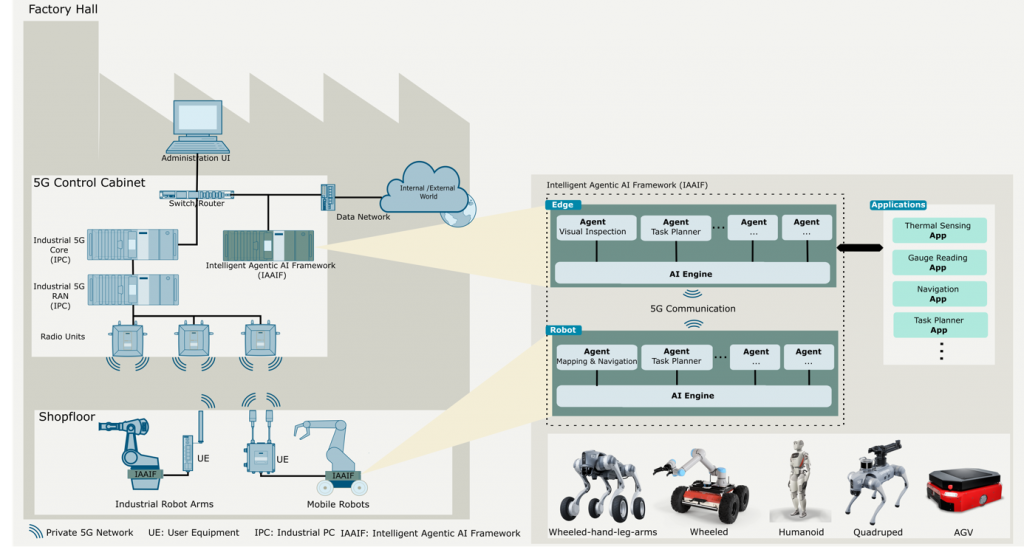
The AXIS (Agentic eXceleration for Intelligent RoboticS) project brings a high level of scientific and technological expertise to agentic artificial intelligence (AI) for smart manufacturing and mobile robot applications. The consortium will develop an innovative framework for enabling advanced autonomy, collaboration, and efficiency in industrial environments. The proposed comprehensive and collaborative solution leverages cutting-edge technologies such as agents, 3D scene reconstruction, image processing algorithms, digital twin, augmented reality/virtual reality (AR/VR) simulation, robot-robot collaboration, and 5G networks to enhance the precision, efficiency, and scalability of these systems. The findings represent significant advancements in state‑of‑the‑art, with the potential to enable transformative breakthroughs in industrial applications.
Short Summary of the Topic:
The scientific quality and innovation potential of this project lie in its multidisciplinary approach, integrating advanced technologies from artificial intelligence, robotics, AR/VR, and 5G networks to develop an intelligent agentic AI framework for mobile robots. The project represents a significant progression beyond the state of the art in mobile robotics and industrial automation by introducing a comprehensive, collaborative solution for autonomous systems in complex and dynamic environments, particularly in visual inspection tasks.
The scientific contribution of the project includes the development of novel AI agents capable of adaptive decision-making and real-time collaboration between mobile robots. This innovation addresses the challenges of task coordination and communication in multi-robot systems, an area that has seen limited research on robust, autonomous collaboration in dynamic industrial settings. By leveraging robot-robot collaboration, the project will advance the understanding of multi-agent systems, particularly in how AI agents can efficiently share tasks and learn from each other in real-time.
In terms of methodological contributions, the use of AR/VR with 3D Gaussian Splatting for simulation and planning represents a cutting-edge approach to improving training and operational planning in mobile robotics. This technology offers high-fidelity visualization that allows for a deeper understanding of robot behaviour, improving decision-making and system design. Additionally, the incorporation of 5G networks in the mobile robotics ecosystem is expected to provide groundbreaking advancements in communication speed and reliability, enhancing the real-time responsiveness and scalability of robot operations in industrial environments.
The conceptual contribution of the project extends to the field of Industry 5.0, where the integration of AI-driven autonomy and robot-robot collaboration offers a paradigm shift in how industries leverage automation. The project will push the boundaries of existing industrial automation systems, which are often limited by rigid, single-robot systems, by introducing a collaborative, adaptive approach that enhances operational efficiency, reduces safety risks, and addresses workforce shortages.
Overall, the project will generate significant progress in mobile robotics, offering a scientific approach to overcoming the existing limitations in robot autonomy, collaboration, and operational flexibility. Its innovations hold the potential to revolutionize industrial processes, improving productivity and safety while contributing to the next phase of digital transformation in industrial automation.
Organizational Approach and the main structure of the Method:
The methodology employed in this project is rigorous, coherent, and comprehensive. The main goal of the project, the design and development of the agentic AI framework. After the preparation of the computing units and equipped mobile robot environments where the proposed framework will be hosted and the establishment of the communication network, the development of sample applications and setting up 5G networks using the technologies underlying the two agent‑based use case scenarios planned to be run on the proposed framework are discussed under subsections separately in the methodology section. The potential of the project enables transformative breakthroughs in industrial applications, and the framework to be developed within the scope of the project will take advantage of new technologies in the future.
On how to contribute to the goals and targets of the call program with the expected targets and outcomes of the project:
The proposed project aligns closely with the scope of the call by focusing on research and experimental development (R&D) to create a technologically new product and improve technological processes. The project aims to develop an agentic-AI framework for mobile robots, an innovative system designed to enhance autonomy, collaboration, and efficiency in industrial applications such as visual inspection tasks. This aligns directly with the call’s objectives of “producing a new product”.
The proposed novel agentic AI framework integrating advanced technologies represents a significant technological advancement in the field of mobile robotics, offering unique capabilities for industrial use. By incorporating high-fidelity 3D simulations and advanced image processing algorithms, the project aims to improve the precision and reliability of visual inspection tasks, ensuring higher-quality outcomes in industrial processes. The collaborative capabilities of the proposed framework, supported by 5G-enabled communication, will optimize task allocation and execution among robotic units, reducing operational costs and improving overall efficiency. Additionally, the framework’s modular and scalable design will facilitate the adoption of standardized processes across various industrial sectors.